
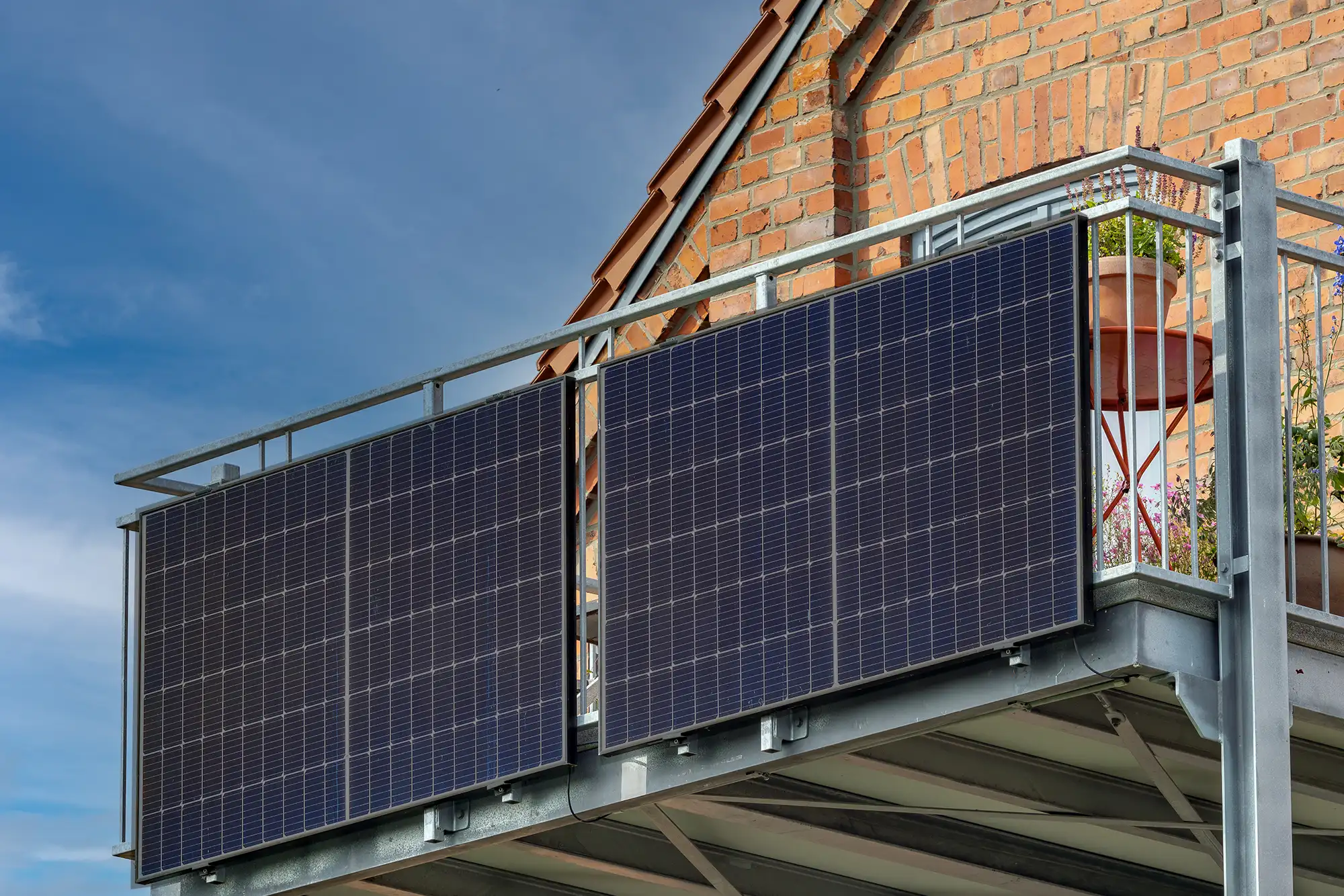
If you’ve seen the buzz around plug-in solar panels and wondered whether they’re actually safe to use… don’t worry, you’re not the only one. Plug-in solar is technically safe if you’re using certified equipment and follow manufacturer guidelines.
On 16 July 2026, the UK government signed and published new legislation that removed the legal grey area surrounding ‘plug-and-play’ solar kits – giving major retailers and safety testing bodies a transition period to certify hardware before law comes into place on 27 August 2026.
If you’re thinking about buying plug-in solar panels for your home, here’s what you need to know before making the purchase.
Are plug-in solar panels safe?
A compliant plug-in solar kit is safe to use. One that isn’t compliant with new legislation might not be – and right now, that distinction matters more than ever. A standard three-pin plug was designed to take electricity out of a socket, and a plug-in solar kit does the opposite. That’s why this needed a change in the law rather than just a new product on a shelf.
The government commissioned independent safety testing before making that change. Six representative kits were tested on UK-style circuits and were found to operate safely within the conditions tested. What that testing didn’t do is approve any individual product for sale.
What makes a plug-in solar kit legal in the UK?
New regulations (SI 2026/848) come into force on 27 August. From that date, a compliant plug-in solar kit can legally be connected to a standard 13-amp socket without needing an electrician to do it for you.
To be compliant, plug-in solar panels must:
- Generate electricity from solar only, with no battery.
- Have a maximum rated AC output of 800 W, measured at the inverter rather than at the panels.
- Be listed on the ENA Type Test Register – the Energy Networks Association’s public list of products approved to connect to the grid.
- Be certified against the government’s Interim Product Specification.
- Be sold as a complete kit, with the panel, inverter, mounting system and factory-fitted cable and plug all certified together.
As per guidelines, you are not able to buy panels from one place, an inverter from another and call the kit compliant. The price of the system can’t guarantee safety either, as an expensive kit that isn’t on the register is just as non-compliant as a cheap one.
As things stand, no plug-in solar product has appeared on the ENA register. Anything on sale today is being sold ahead of the rules it will need to meet, so checking that register before you buy is crucial.
Where can and can’t you install plug-in solar panels?
The cable that comes in the box is the cable you have to use for installation. These rules don’t allow a plug-in solar kit to be connected through an extension lead, a multi-way adaptor or a plug-in RCD adaptor. You also can’t cut the cable and splice in extra length. The plug and lead are fitted at the factory and go straight into a wall socket – whatever length the manufacturer supplies is the working length you get to install.
There are also places a kit can’t be installed, including:
- Buildings with aluminium composite, metal composite, high-pressure laminate or timber cladding.
- Timber balconies.
- Any building currently undergoing external wall fire safety work.
But balcony railings, brick and rendered walls are all perfectly fine, provided the panels are fixed with suitable brackets. If you’re unsure or not confident about how they will hold, they’re a lot safer on the ground.
By ground-mounting your plug-in solar panels in a garden bypasses the balcony and cladding restrictions altogether, which makes it the simplest option for most households. But check you have a suitable outdoor socket within reach of the cable first. Shed and garage sockets often aren’t wired to a standard that would take one, and running a new supply to an outbuilding needs a qualified electrician.
On the panel size, total panel output of up to 2,000 W DC is permitted, but the specification recommends a professional assessment above 960 W.
Do you need to tell anyone you’ve installed plug-in solar panels?
Yes, you do, but it’s more straightforward than you think. You will need to notify your Distribution Network Operator (DNO), the company that owns the cables and poles in your area, not your energy supplier. This happens under a set of grid rules called G98.
You install the kit, then fill in a short online form within 28 days to tell them it’s there. It’s free, takes around 15 minutes, and you can’t be turned down.
Three other things worth checking:
- One plug-in solar kit per household: The product specification allows one per circuit, but the grid rules still say one per household – and the grid rules are the ones that govern your connection.
- Permission, if you don’t own the building: If you rent or your home is leasehold, fixing anything to the building usually needs written permission, even though the kit itself is portable. Ground-mounting in the garden avoids that, though it’s worth checking your tenancy or lease.
- Your home insurer: It’s worth a quick call to let them know it’s there.
And, if you already have standard solar PV panels on your roof, speak to an installer first. The extra capacity could push your home over the threshold for the simple notification route and into a formal grid application.
Can you add a battery to plug-in solar panels?
Not under these rules currently. The regulations specifically exclude any device designed to import electricity for storage, and that exclusion sits in the law itself.
That said, this is an evolving space, and the government has said work will begin on a longer-term product standard. While there’s no exact date for it, we’re expecting batteries for plug-in solar systems could be available within the next 6–12 months.
What should you do next?
If you’re still working out whether plug-in kits are right for your home, we’ve covered what these systems are, who they suit and how they compare with a full rooftop installation. You can read our blog on plug-in solar panels here. As these plug-in solar systems develop further, we’ll continue to share updates as soon as we hear them – including how you can best get involved and what support may be available.
If plug-in solar panels aren’t right for you but want to get in on the renewable action – check your eligibility for rooftop solar panels with Utilita Home. You could save up to £1,2751 each year on your energy bills – plus, with finance options starting from £50 a month, going solar could be easier than you think.
1 This figure is based around a large electricity usage home in the UK (using roughly 5700 kWh per year). You can save up to £916 per year by installing a 16-panel system with our 5.32kWh battery storage. You can also earn up to a further £359 per year by exporting excess energy back to the grid at an electricity export rate of 12p per kWh. The calculations follow MCS standard procedure and assume a self-consumption rate of 54% for systems with battery storage and 22% for those without. The current unit rate is based on the energy price set by Ofgem at 26.103/kWh. Actual savings may vary depending on the specific equipment chosen and your precise annual energy consumption. Savings may also vary dependent on your property location and any obstacles which could cause your roof to be in shade, reducing the solar generation as a result. ↩